Image

Westmount Park – Flowering Trees (Eudicotylendons)


Westmount Park - Flowering Trees (Eudicotylendons)

Westmount Park’s Lime (Tilia) Trees

This article appeared in the Westmount Independent, September 16th. 2014

I am sure we all seen this rangy tree by the gazebo and, like myself, never given it a second thought.

For the record, its girth measures 3.5 meter and its neighbour is 2.7 meters.  That makes the former well over 300 years old, and the latter (a youngster) at about 230 years!  One can just imagine what a different place this was when the trees where saplings.

This tree, now old and diseased, is a Lime (Tilia) commonly known, in North America, as Basswood.

This species dates back to antiquity and was sacred to the Celts.  Venus, the goddess of love, is mentioned in the tree’s heart-shaped leaves.

These trees, like sentinels offering shade, form a row on either side of the footpath between the gazebo and the lagoon

If the trees were pollarded (removing the upper branches) they would offer a scent that has been described by one author as “for the first time that embraces me every day with the true, the peerless lime-flower scent, making me skip and pirouette unmindful of my rickety knee.”

Not surprisingly, these trees are measured in centuries.  For example, a Lime in Westonbirt Arboretum in Gloucestershire is estimated to be 2,000 year old, another in Naters, Switzerland, still extant, was first mentioned 1357.

Greek mythology tells the story of Zeus and Hermes visiting the land of the mortals and finding that the only house that would offer them shelter belonged to Philemon and Baucis.  To reward them for their hospitality the gods granted their wish:  to be together after death. When the time came Zeus, true to his word, turned Philemon into an Oak and Baucis into a Lime tree to stay together for eternity.

Perhaps that is the reason that there are many Oak trees are planted adjacent the parks’ Limes!

Image

43 Arlington Avenue

43 Arlington Avenue

F. C. Silcock – Manager Bovril Company (1897).

Bovril was initially manufactured in Montreal from 1879-1884 (I find that amazing!) until a fire destroyed their operations.

In 1884 the company relocated to London, England.

From Wikipedia:

“In 1870, in the Franco-Prussian War, Napoleon III ordered one million cans of beef to feed his troops. The task of providing all this beef went to a Scotsman living in Canada named John Lawson Johnston.

Large quantities of beef were available across the British Dominions and South America, but its transport and storage were problematic. Therefore, Johnston created a product known as ‘Johnston’s Fluid Beef’, later called Bovril, to meet the needs of Napoleon III.

By 1888, over 3,000 British public houses, grocers and chemists were selling Bovril. In 1889, the Bovril Company was formed.”

Image

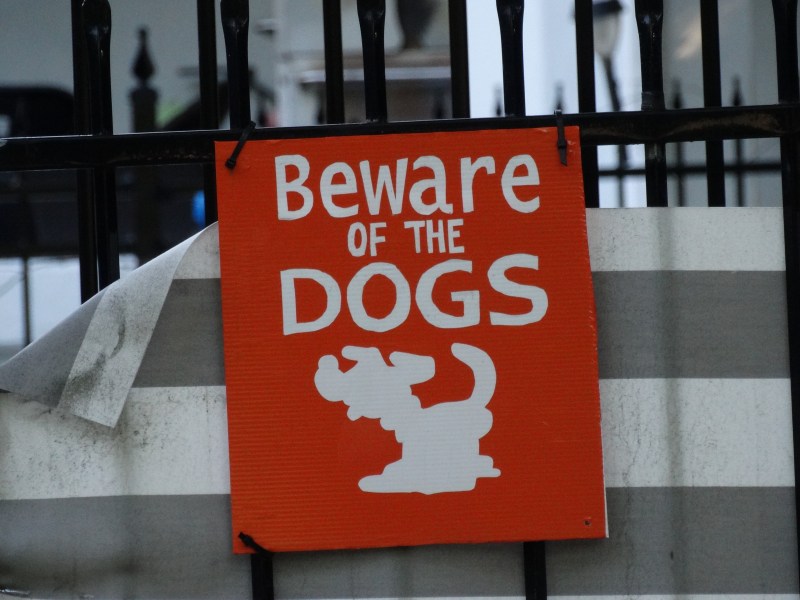
Dire Warning!

Dire Warning!

Dogs living behind the clay tennis courts at Westmount Park.

What follows is an interesting interpretation from http://www.city-data.com/forum/dogs/1538470-beware-dog.html concerning putting these signs on one’s property:

“On the more serious side of posting a “beware of dog” sign on your property, you may want to think twice before doing it.

Most people who see one of these signs, and those that put them up, think it will be a deterrent to unwanted elements entering one’s private property.

This may be so, but from what I have read regarding cases brought before the courts, and witnessed as a juror, in dog biting cases, having these signs posted on your property has just the opposite effect from what it was intended.

When a case comes before the court, usually the defendant (the dog owner) tells the court “we had the property posted, warning anyone that enters,the dog is in the yard, and to beware “.

So the judge would ask, “beware of what”?

Defendant answers, “Beware the dog may attack if you enter the property”.

In this case before the court, a service tech (the plaintiff,a meter reader) entered the property, and the dog bit him.

So the judge addresses the defendant, and ask,” By having a sign stating “beware of dog”, you are telling every one you have a dog that in all probability would attack, or bite an intruder?”

Defendant replies, “Yes, the possibility is there”.

Judge replies,”You are in fact, by posting that sign, telling everyone you are harboring a vicious dog that will attack with probable cause.”

“You are making it aware that you posses an animal that will attack, and possibly bite.”

“By doing that, you have to be aware of the consequences of your dog attacking someone, and that is why situations like this end up in court.”

Defendant argues, “The sign is there to ward off intrusion on to private property.”.

This defense never works.

The way the court looks at it is, posting a “beware of dog” sign is an admission by the dog owner that their dog is prone to attack an intruder, even if the dog has, or would never do that.

You are in essence, telling the public your dog is dangerous.

You would do well to think twice before putting one up on your property.

In these cases, the plaintiff almost always secures a judgement against the dog owner.

Read more: http://www.city-data.com/forum/dogs/1538470-beware-dog-bite-legal-best-outside.html#ixzz35ytDJg8R