Image

Gargoyles

Gargoyles

Gargoyles over the former Bank of Nova Scotia at Green & St. Catherine.

Gargoyle origins from Wikipedia:

“A French legend that sprang up around the name of St. Romanus (“Romain”) (AD 631–641), the former chancellor of the Merovingian king Clotaire II who was made bishop of Rouen, relates how he delivered the country around Rouen from a monster called Gargouille or Goji. La Gargouille is said to have been the typical dragon with batlike wings, a long neck, and the ability to breathe fire from its mouth.

There are multiple versions of the story, either that St. Romanus subdued the creature with a crucifix, or he captured the creature with the help of the only volunteer, a condemned man. In each, the monster is led back to Rouen and burned, but its head and neck would not burn due to being tempered by its own fire breath.

The head was then mounted on the walls of the newly built church to scare off evil spirits, and used for protection. In commemoration of St. Romain, the Archbishops of Rouen were granted the right to set a prisoner free on the day that the reliquary of the saint was carried in procession.”
Image

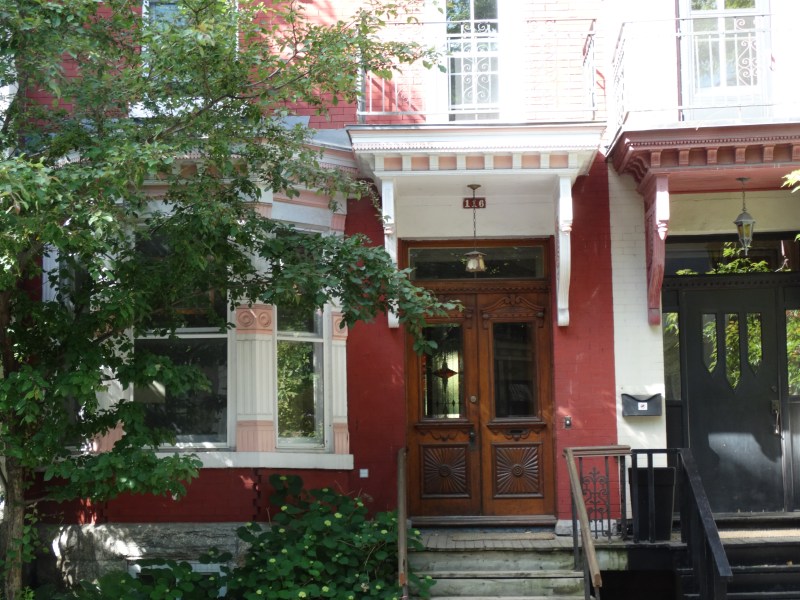
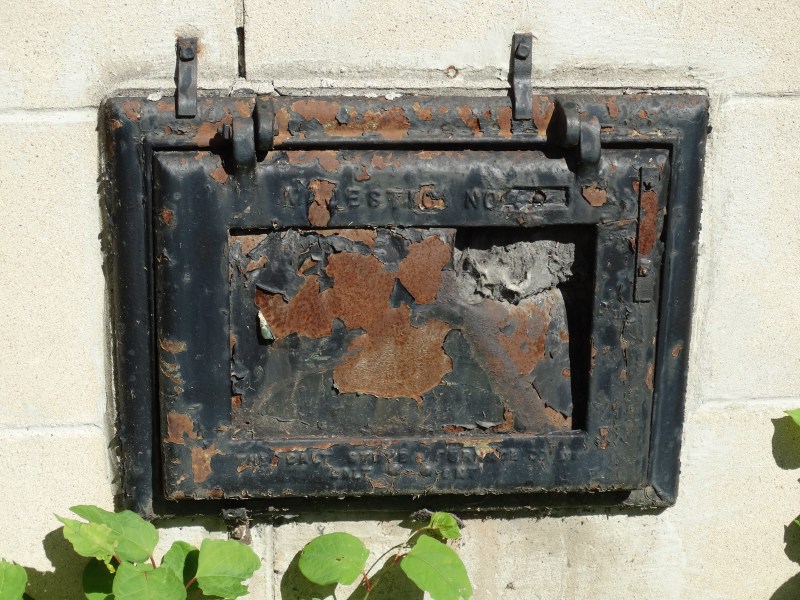
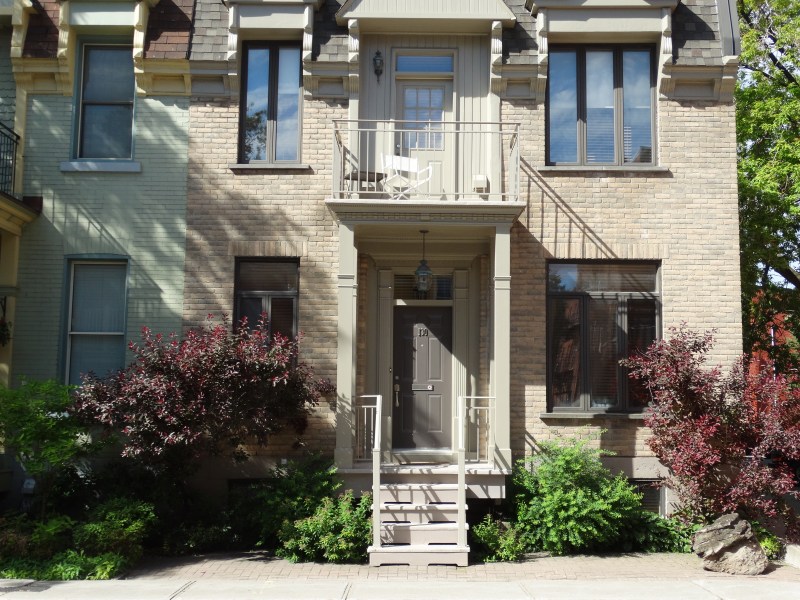
115 Lewis Avenue

115 Lewis Avenue

H. W. Aird (1897) – Treasurer of the Canada Paint Company.

Advertisement from the Monetary Times, April 24, 1903:

“Dry colors and coach painting materials of every description are manufactured in Montreal by this company. The waters of the Lachine Canal are harnessed to powerful turbines; steam and electricity also being employed.

The most extensive oxide and graphite mines for the production of paints in the Dominion of Canada are owned by the Canada Paint Company. One branch of the company is entirely devoted to grinding and maturing White lead, and amongst their brands may be mentioned the “Painters’ Perfect” white lead, which is beautifully soft and fine in the grain. It mixes well with linseed oil, forming a creamy, smooth paint of great covering power and undoubted durability.”

Image

What could have been (and should have been)…..

What could have been (and should have been)…..

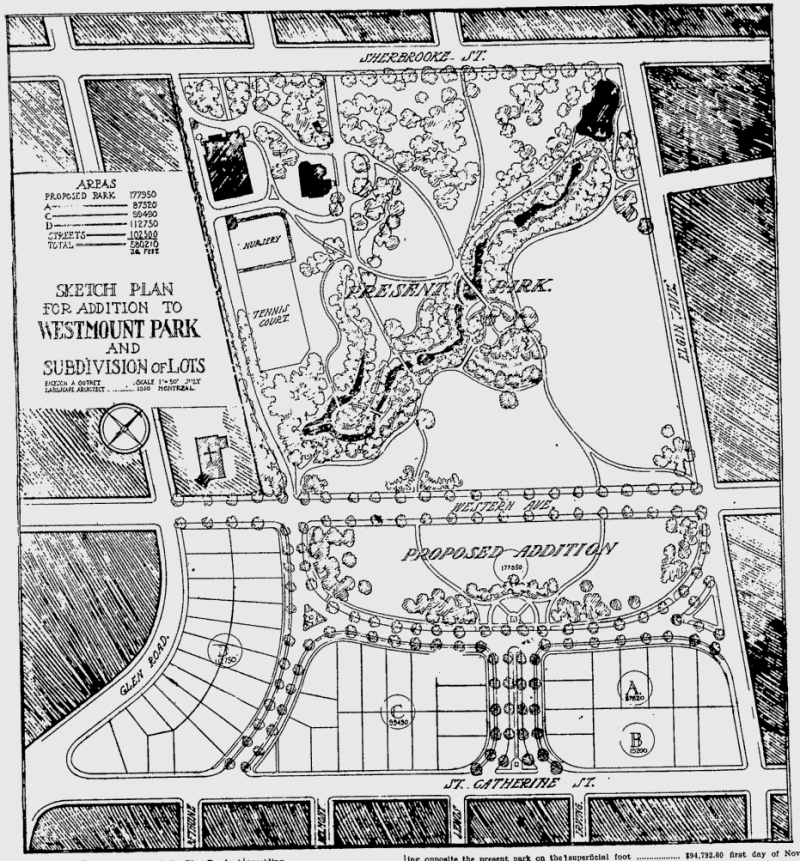
In the process of researching various, Westmount related, topics a newspaper a headline “Westmount Will Have One Of The Finest Laid Out Parks on the Continent” caught my attention.

The article that followed was in the Westmount News August 5, 1910. It provided details of a new Park Extension By-Law (221) that was passed by City Council. The City was taking a $300,000 loan to procure 5 additional acres for the purpose of extending the current park. A large portion of this land was from “Dame Margaret Smith et. al.” and the Estate of William Smith. This comprised the area between Western Avenue (now Boulevard De Maisonneuve) and St. Catherine Street, the Glen Road, Lansdowne Avenue and bordering Elgin Avenue (now Melville Avenue).

The City’s landscape architect, R. A. Outhet, proposed two crescent driveways joining Western Avenue: one from Elgin Ave. and the other following the path of Glen Road.

In addition, a boulevard entrance to the park would connect from St. Catherine Street “giving a stately entrance to the park”. Council stated that this would “increase the beautification of the city which so far has been laid out too much of straight lines”.

The By-Law also provided power to Council to sell land fronting St. Catherine St. and Lansdowne Ave. to pay for the park extension.

One can only speculate what the causes were to abandon this 100 year-old vision and create the park’s current landscape and configuration.

On another note, the same 1910 edition of the Westmount News had the following item:

“The council is now considering a proposal to erect a Museum, towards which substantial support has been generously promised by Mr. David Ross McCord, K.C., the well-known antiquarian of Temple Grove, whose collection of historic relics is the best and most complete in the continent.”

For some reason, eleven years later, David McCord donated his entire collection elsewhere forming the McCord National Museum located in a building provided by McGill University. The museum, today, is known as the McCord Museum and located at 690 Sherbrooke Street West.