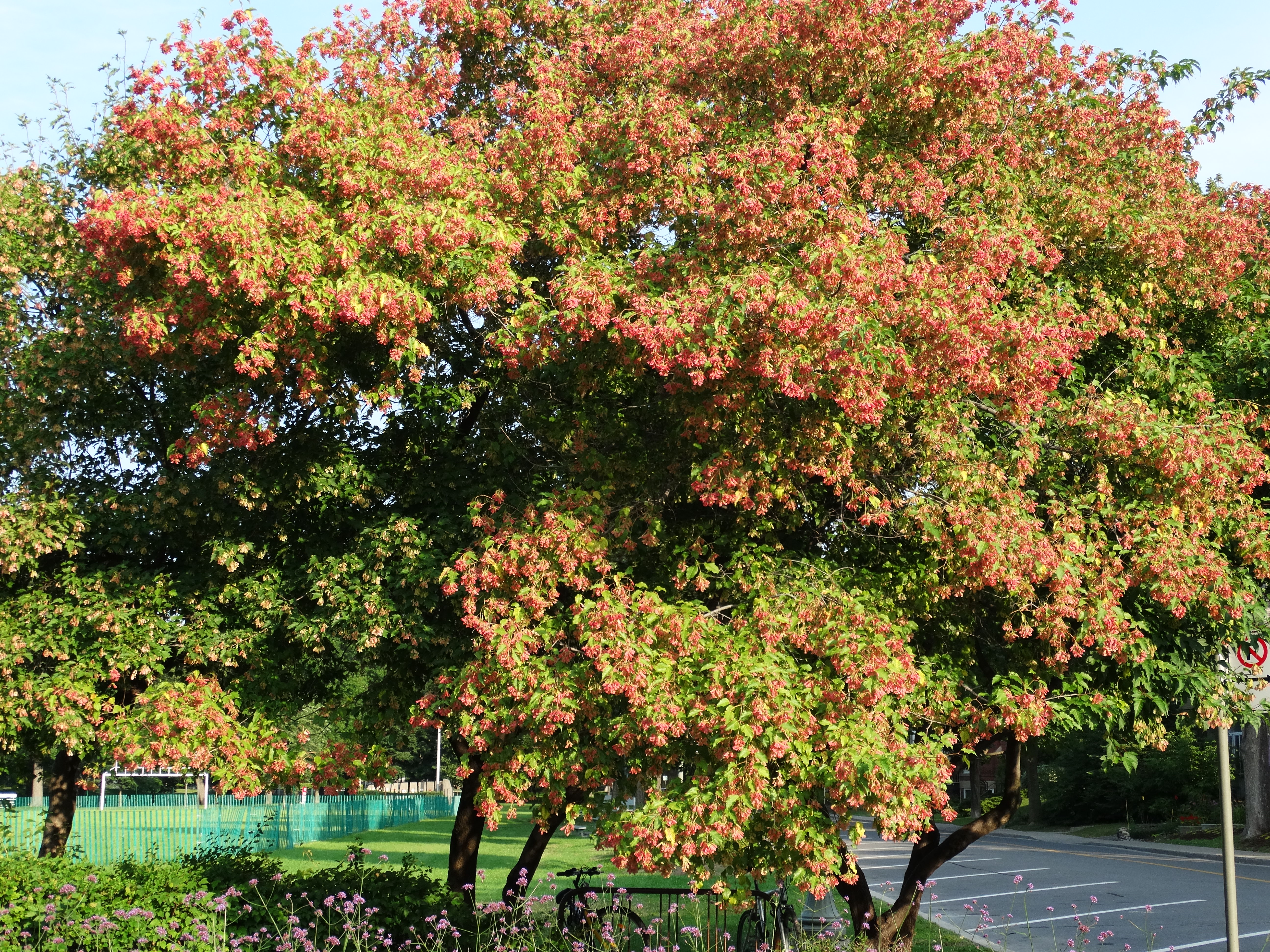
An Amur Maple at one of the Melville Avenue entrances to Westmount Park. The tree’s seed cases are turning a beautiful red colour this time of year.
An Amur Maple at one of the Melville Avenue entrances to Westmount Park. The tree’s seed cases are turning a beautiful red colour this time of year.

A beautiful summer sunset over the park.
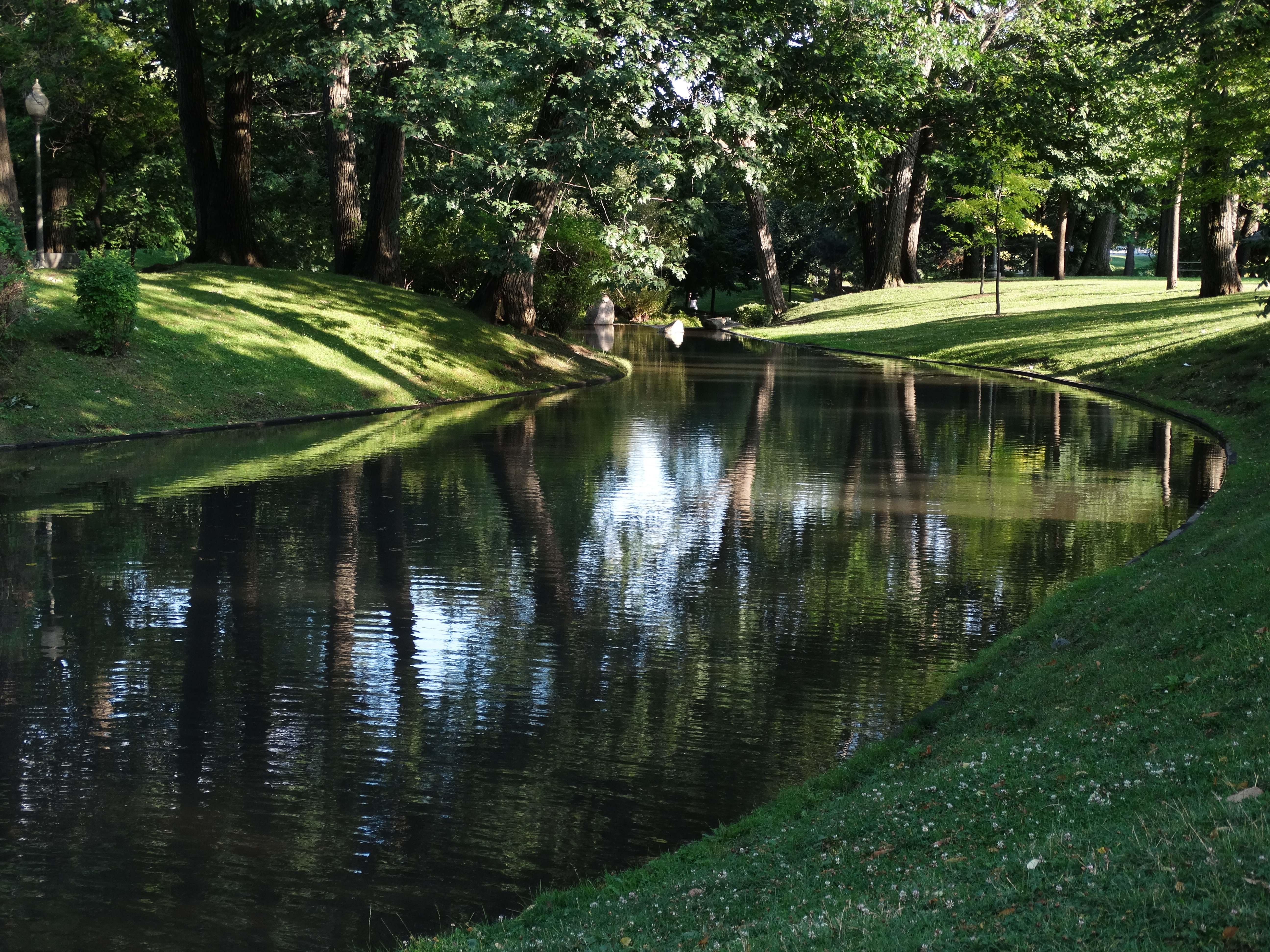
The park’s lagoon early in the evening.
These lagoons are the “remnants” of the Glen Stream that used to run flow through this area. The various tributaries of the stream were buried, years ago, and diverted into conduits to allow for residential development.
I have seen City workers use metal stair steps to enter a deep manhole, near the public library, to adjust a valve that controls the volume of water that enters these lagoons. I am not sure if it is from a municipal water source for from the original stream. (I should have asked!)
Today, the stream runs underground south, through the park, towards Lansdowne Avenue and Saint Catherine Street, then under the arched Canadian Pacific Railway (CPR) railroad bridge, towards Saint Henri.
Apparently, there is a sewer cover in the middle of Lansdowne Avenue and Saint Catherine, in front of the CPR railway arch, where one can still hear the rushing waters of this stream.
(One would have to take their own “lives into their hands” to verify this!)
I recently came across the term “daylighting” that refers to resurrecting former urban streams. One can only imagine “daylighting” the Glen Stream, it is not such a “crazy idea” – it has occurred successfully elsewhere.
http://www.foxnews.com/us/2010/04/24/plans-percolate-revive-sf-native-creeks/
SAN FRANCISCO – SAN FRANCISCO (AP) — Riffling through old maps while researching a history project for San Francisco public schools, landscape architect Bonnie Sherk made a discovery: a century ago a creek coursed where two school campuses stand today.
“There was Islais Creek, running where Balboa High School is now,” said Sherk. “All of a sudden it made sense: the school’s cafeteria had been flooding and the basements of homes in this neighborhood flood during heavy rains because they’re in this large watershed.”
Two wells have been drilled on the school campuses since Sherk’s discovery a decade ago, tapping the hidden creek’s water to irrigate community gardens, parks and street vegetation, while hopefully reducing the threat of floods.
Now, as part of an estimated $4 billion sewer upgrade, Islais Creek and other streams that last saw daylight more than a century ago could flow openly once again through neighborhoods of one of the country’s most densely built cities.
Such “daylighting” of urban creeks is being embraced in cities throughout the world. Seattle, Portland, Ore., Yonkers, N.Y., Providence, R.I., as well as Zurich are among many places reopening long hidden waterways. Resurrecting old creeks can help remove hundreds of millions of gallons of storm water from sewer systems each year — meaning fewer sewage spills and cleaner water.
Covered up during and after the Gold Rush when the city’s booming population created demand for housing, San Francisco’s many creeks were diverted and sent underground into the sewer system — parts of it still utilizing 1850s-era brick pipes. The water is mixed with the waste and sent to a treatment plant before being expelled into San Francisco Bay or the Pacific Ocean.
Each year, these rain-swollen creeks often overload the system — and about a dozen times a year raw or partially treated sewage spews into the bay and sea.
Currently, Islais Creek, once the city’s largest, can only be seen in a park in the southern part of the city, where it flows into concrete sewer pipes.
The only place people can catch a glimpse of Mission Creek is in the basement of the San Francisco National Guard Armory and Arsenal building, a massive brick structure not open to the public and currently owned by a pornography film company.
“We want to partially restore the natural hydrology of San Francisco,” said Tyrone Jue, spokesman for San Francisco’s Public Utilities Commission, the agency in charge of the project. “It helps the sewer system by reducing flow, beautifies neighborhoods and can bring back natural wildlife that may once have lived in an area.”
San Francisco is studying the best sites for unearthing these historic creeks, and officials say the first phase of projects would likely start in five to 10 years.
Islais Creek, which starts in the city’s Glen Park neighborhood, and Mission Creek, which runs beneath the trendy Mission and South of Market districts, are likely the first candidates.
Both creeks flow toward the bay through densely packed neighborhoods, which could expose the water to pollutants such as auto runoff and garbage.
Berkeley in the 1980s opened a stretch of Strawberry Creek in a public park. But after heavy rains the creek filled with a lot of debris.
Still, regulators say with proper monitoring and natural filters, opening the creeks can actually improve overall water quality by reducing raw sewage overflows.
“Growing plants and vegetation along the creek banks can be very efficient in filtering pollutants and making sure the water going into the bay is better quality,” said David Smith, manager of Clean Water Act permits for the U.S. Environmental Protection Agency office in San Francisco. “There’s a lot of environmental benefit in turning streams back into living systems.”
Seattle has many urban creeks, most of which have had some sections reopened or restored in recent decades.
These projects have improved water quality and reintroduced wildlife into a populated urban area, said Judith Noble, a strategic adviser for Seattle Public Utilities.
Yet the process has been vexing at times, and full of challenges, Noble said. Some creeks have become healthy habitat for spawning salmon and other wildlife, yet other creeks have been polluted from urban runoff, increasing fish deaths. Federal fisheries managers are studying the fish deaths, Noble said, trying to figure out the toxins responsible.
“Our story is both positive and puzzling,” she said. “Daylighting is an admirable venture, but it can also get very complicated very quickly.”
Though San Francisco city creeks will never flow as they once did, those working to expose them see benefits for the city and its residents.
“It turns a negative in terms of flooding and property damage into a positive,” said Sherk. “The community can use the water for irrigation, help mitigate flooding, improve the environment and have an educational resource for the schools.””
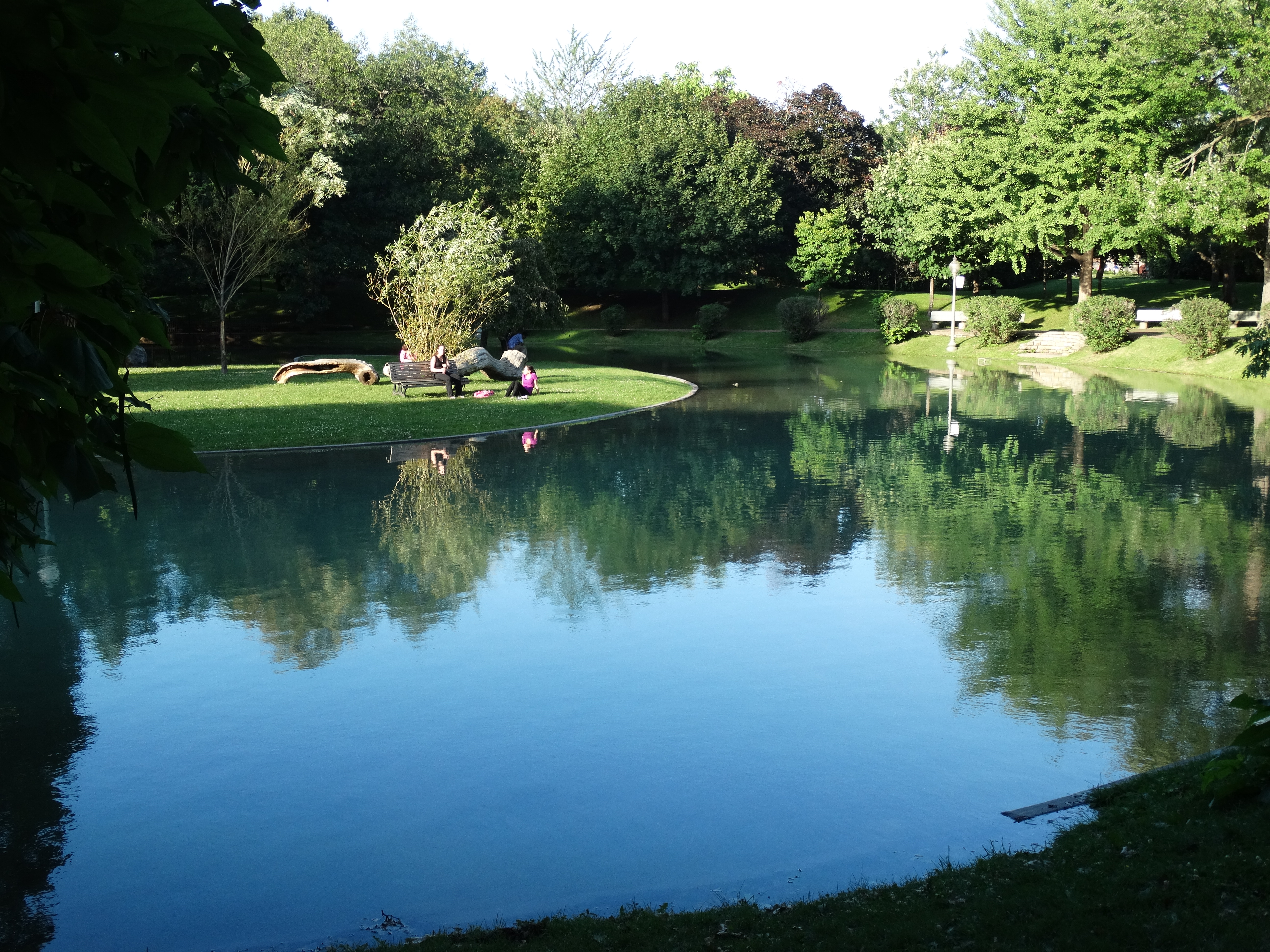
The park’s lagoon during an early summer evening. It had rained earlier in the day causing the water to become murky and reflect the blue sky.
A version of this article appeared in the Westmount Independent, August 26th. 2014
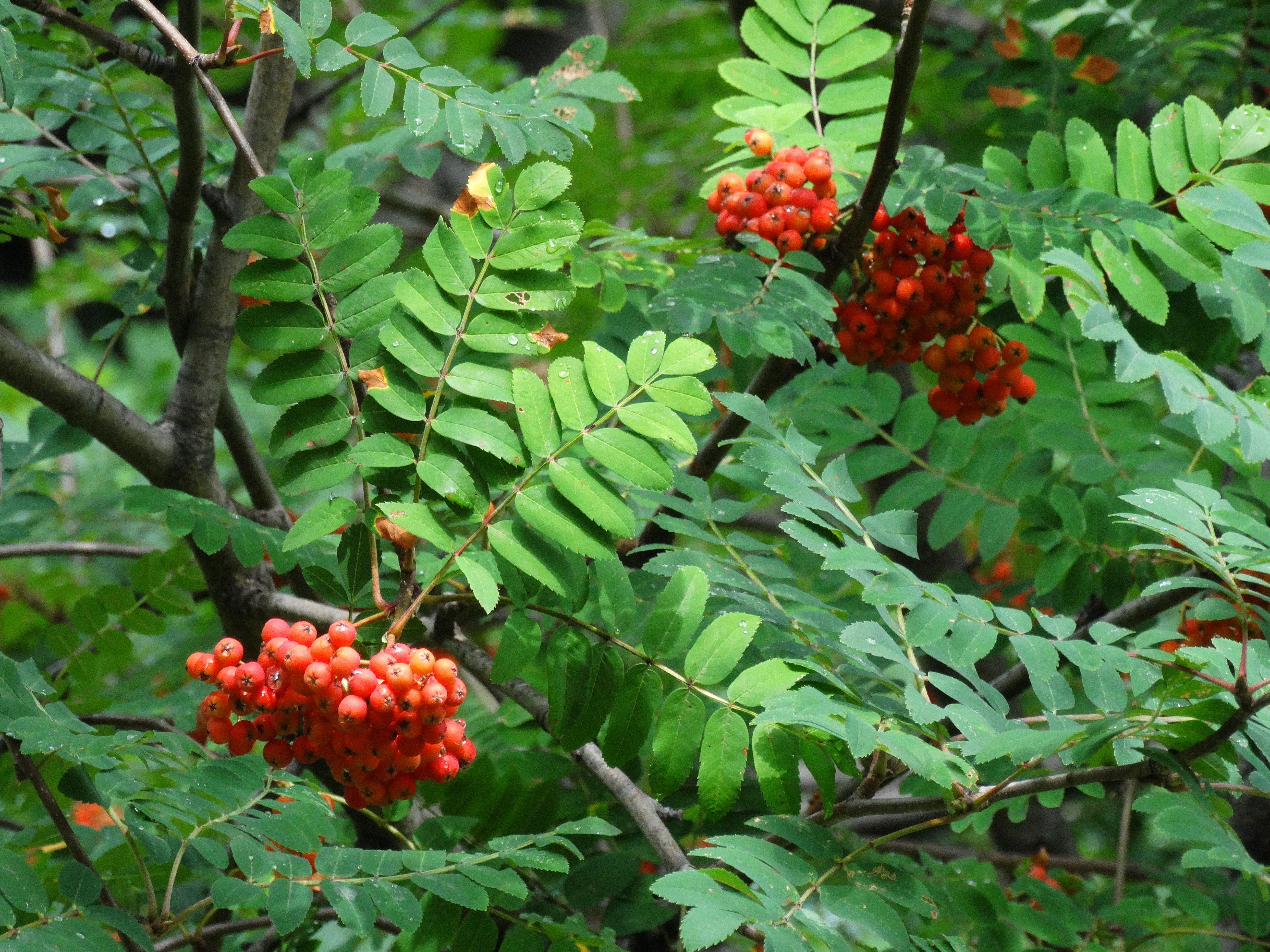
A Rowan tree (commonly known as “Mountain Ash”) in Westmount Park.
The tree has a fascinating history:
From: http://www.treesforlife.org.uk/forest/mythfolk/rowan.html
“The rowan’s mythic roots go back to classical times. Greek mythology tells of how Hebe the goddess of youth, dispensed rejuvenating ambrosia to the gods from her magical chalice. When, through carelessness, she lost this cup to demons, the gods sent an eagle to recover the cup. The feathers and drops of blood which the eagle shed in the ensuing fight with the demons fell to earth, where each of them turned into a rowan tree. Hence the rowan derived the shape of its leaves from the eagle’s feathers and the appearance of its berries from the droplets of blood.
The rowan is also prominent in Norse mythology as the tree from which the first woman was made, (the first man being made from the ash tree). It was said to have saved the life of the god Thor by bending over a fast flowing river in the Underworld in which Thor was being swept away, and helping him back to the shore. Rowan was furthermore the prescribed wood on which runes were inscribed to make rune staves.
In the British Isles the rowan has a long and still popular history in folklore as a tree which protects against witchcraft and enchantment. The physical characteristics of the tree may have contributed to its protective reputation, including the tiny five pointed star or pentagram on each berry opposite its stalk (the pentagram being an ancient protective symbol). The colour red was deemed to be the best protection against enchantment, and so the rowan’s vibrant display of berries in autumn may have further contributed to its protective abilities, as suggested in the old rhyme: “Rowan tree and red thread / make the witches tine (meaning ‘to lose’) their speed”. The rowan was also denoted as a tree of the Goddess or a Faerie tree by virtue (like the hawthorn and elder) of its white flowers.
Rowan has had a wide range of popular folk names, the most well-know being mountain ash. Its old Gaelic name from the ancient Ogham script was Luis from which the place name Ardlui on Loch Lomond may have been derived. The more common Scots Gaelic name is caorunn (pronounced choroon, the ch as in loch), which crops up in numerous Highland place names such as Beinn Chaorunn in Inverness-shire and Loch a’chaorun in Easter Ross. Rowan was also the clan badge of the Malcolms and McLachlans. There were strong taboos in the Highlands against the use of any parts of the tree save the berries, except for ritual purposes. For example a Gaelic threshing tool made of rowan and called a buaitean was used on grain meant for rituals and celebrations. The strength of these taboos did not apply in other parts of Britain it seems, though there were sometimes rituals and timings to be observed in harvesting the rowan’s gifts (for example the rule against using knives to cut the wood, mentioned above).
The rowan’s wood is strong and resillient, making excellent walking sticks, and is suitable for carving. It was often used for tool handles, and spindles and spinning wheels were traditionally made of rowan wood. Druids used the bark and berries to dye the garments worn during lunar ceremonies black, and the bark was also used in the tanning process. Rowan twigs were used for divining, particularly for metals.
The berries can be made into or added to a variety of alcoholic drinks, and different Celtic peoples each seem to have had their favourites. As well as the popular wine still made in the Highlands, the Scots made a strong spirit from the berries, the Welsh brewed an ale, the Irish used them to flavour Mead, and even a cider can be made from them. Today rowan berry jelly is still made in Scotland and is traditionally eaten with game.”

Walking our dog this evening by the lagoon someone, sitting on a park bench with two small dogs, asked me if there were still seven (like me, she counted them) ducklings. I replied that that the entire family is still “accounted for”.
It seems that this duck family has been “adopted” by those of us that use the park on a regular basis.
Hopefully, this will ensure their safety. I am still concerned what might happen overnight in the park, despite the City’s curfew.

Westmount Park’s Lime (Tilia) Trees
This article appeared in the Westmount Independent, September 16th. 2014
I am sure we all seen this rangy tree by the gazebo and, like myself, never given it a second thought.
For the record, its girth measures 3.5 meter and its neighbour is 2.7 meters. That makes the former well over 300 years old, and the latter (a youngster) at about 230 years! One can just imagine what a different place this was when the trees where saplings.
This tree, now old and diseased, is a Lime (Tilia) commonly known, in North America, as Basswood.
This species dates back to antiquity and was sacred to the Celts. Venus, the goddess of love, is mentioned in the tree’s heart-shaped leaves.
These trees, like sentinels offering shade, form a row on either side of the footpath between the gazebo and the lagoon
If the trees were pollarded (removing the upper branches) they would offer a scent that has been described by one author as “for the first time that embraces me every day with the true, the peerless lime-flower scent, making me skip and pirouette unmindful of my rickety knee.”
Not surprisingly, these trees are measured in centuries. For example, a Lime in Westonbirt Arboretum in Gloucestershire is estimated to be 2,000 year old, another in Naters, Switzerland, still extant, was first mentioned 1357.
Greek mythology tells the story of Zeus and Hermes visiting the land of the mortals and finding that the only house that would offer them shelter belonged to Philemon and Baucis. To reward them for their hospitality the gods granted their wish: to be together after death. When the time came Zeus, true to his word, turned Philemon into an Oak and Baucis into a Lime tree to stay together for eternity.
Perhaps that is the reason that there are many Oak trees are planted adjacent the parks’ Limes!

Dogs living behind the clay tennis courts at Westmount Park.
What follows is an interesting interpretation from http://www.city-data.com/forum/dogs/1538470-beware-dog.html concerning putting these signs on one’s property:
“On the more serious side of posting a “beware of dog” sign on your property, you may want to think twice before doing it.
Most people who see one of these signs, and those that put them up, think it will be a deterrent to unwanted elements entering one’s private property.
This may be so, but from what I have read regarding cases brought before the courts, and witnessed as a juror, in dog biting cases, having these signs posted on your property has just the opposite effect from what it was intended.
When a case comes before the court, usually the defendant (the dog owner) tells the court “we had the property posted, warning anyone that enters,the dog is in the yard, and to beware “.
So the judge would ask, “beware of what”?
Defendant answers, “Beware the dog may attack if you enter the property”.
In this case before the court, a service tech (the plaintiff,a meter reader) entered the property, and the dog bit him.
So the judge addresses the defendant, and ask,” By having a sign stating “beware of dog”, you are telling every one you have a dog that in all probability would attack, or bite an intruder?”
Defendant replies, “Yes, the possibility is there”.
Judge replies,”You are in fact, by posting that sign, telling everyone you are harboring a vicious dog that will attack with probable cause.”
“You are making it aware that you posses an animal that will attack, and possibly bite.”
“By doing that, you have to be aware of the consequences of your dog attacking someone, and that is why situations like this end up in court.”
Defendant argues, “The sign is there to ward off intrusion on to private property.”.
This defense never works.
The way the court looks at it is, posting a “beware of dog” sign is an admission by the dog owner that their dog is prone to attack an intruder, even if the dog has, or would never do that.
You are in essence, telling the public your dog is dangerous.
You would do well to think twice before putting one up on your property.
In these cases, the plaintiff almost always secures a judgement against the dog owner.
Read more: http://www.city-data.com/forum/dogs/1538470-beware-dog-bite-legal-best-outside.html#ixzz35ytDJg8R ”

It never ceases to amaze me seeing the different modes of transportation that use the park’s bicycle paths. (I also recall seeing automobiles!).
 Westmount Overlooked